guide / scoring

How often does a padel set reach a tie-break?

Explore 25,143 completed standard-set scores, compare scoring formats and see why a set tie-break and a 10-point match decider need different denominators.

Quick answer

In the four named scoring formats in our selected sample, 1,795 of 25,143 recognised completed standard-set scores ended 7-6 or 6-7: 7.1%. That is a share of recorded sets, not the chance that any match or player will reach a tie-break. The interactive score heatmap lets you inspect counts and within-format shares. Partial sets, unused set markers and match tie-break point scores are excluded.

Score on your Watch.
Review on your iPhone.

Download Padel Pointer for iPhone and Apple Watch.

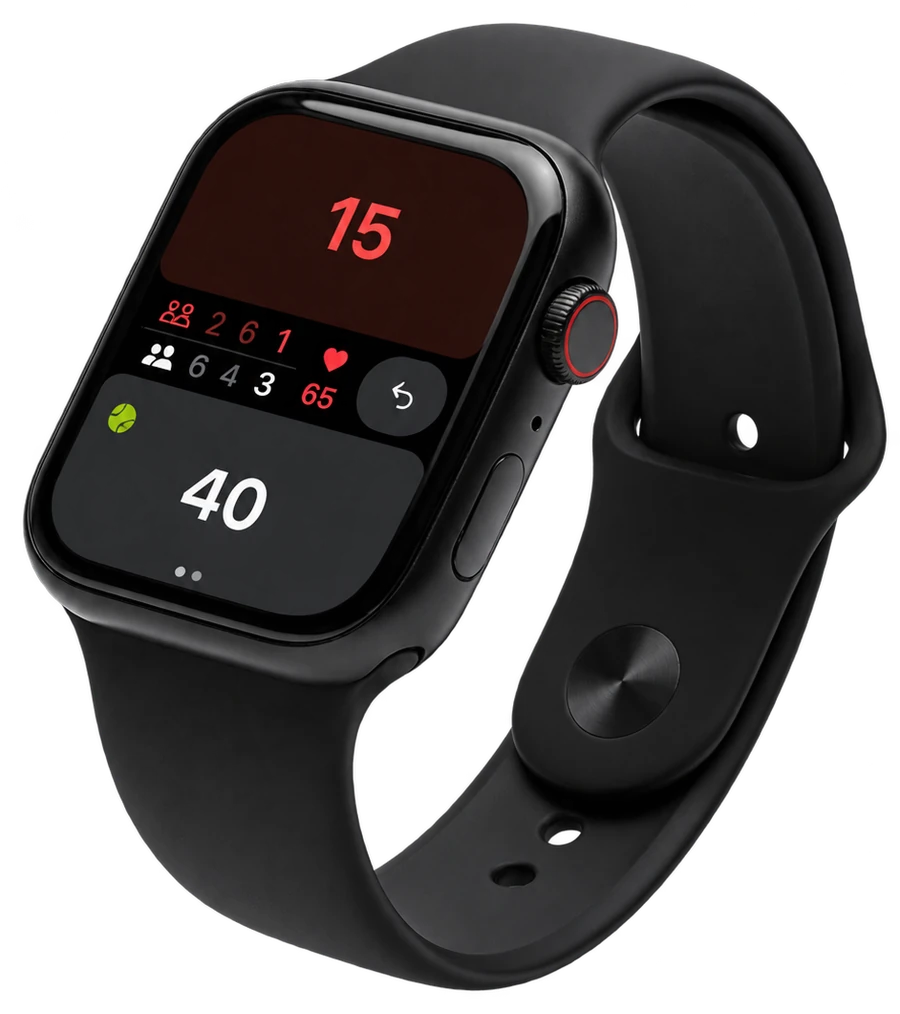
Padel Pointer showing a live padel score on Apple Watch

Explore the scores that finish a set

Select any cell to see its denominator and sample size. Switch between counts and within-format shares to compare groups of different sizes.

Compare by

Advantage · 7-6: 1,078 of 15,148 valid set scores (7.1%). 475 profiles contributed to this cell. Select a cell to explore.

Set winner’s scoreAdvantageGolden PointSilver PointStar Point
6-0
6-1
6-2
6-3
6-4
7-5
7-6

Darker = more common within the selected measure. Share uses each format’s valid-set total, not its match count. Both orientations are combined (6-7 becomes 7-6). A 7-6 finish signals a set tie-break; it does not reveal the tie-break points.

Read the chart data as a table
FormatSet winner’s scoreSet scoresProfiles contributing
Advantage6-01,472598
Advantage6-12,428800
Advantage6-23,015824
Advantage6-33,069837
Advantage6-42,792832
Advantage7-51,294554
Advantage7-61,078475
Golden Point6-0444185
Golden Point6-1693251
Golden Point6-2799266
Golden Point6-3839252
Golden Point6-4794265
Golden Point7-5340162
Golden Point7-6289145
Silver Point6-0233107
Silver Point6-1452144
Silver Point6-2575149
Silver Point6-3625160
Silver Point6-4548144
Silver Point7-522697
Silver Point7-619785
Star Point6-022697
Star Point6-1431124
Star Point6-2556136
Star Point6-3606141
Star Point6-4628140
Star Point7-526398
Star Point7-623193

Padel Pointer original research. 17 August–14 November 2026 inclusive; UTC. Production Watch records, internal/test accounts excluded, exact event UUID deduplication. Extracted 15 November 2026. Aggregate cells only; no personal identities, health readings or precise locations. 25,143 recognised completed standard-set scores in the four named formats. Both score orientations combined; partial sets, 0-0 markers, nonstandard ends and match tie-break points excluded.

Count sets when the question is about a set

A match can contain several sets. Counting matches that include a tie-break would answer a different question from counting sets that finish with one. Our main denominator is therefore 25,143 recognised standard-set score strings across Advantage, Golden Point, Silver Point and Star Point.

We combined both orientations of each final score: a 6-7 and a 7-6 record both enter the 7-6 row. Of those valid scores, 1,795 ended in a set tie-break. The remaining 23,348 finished at another recognised standard-set score. This is a descriptive result from selected app records, not an estimate of the probability for every padel set.

Use the heatmap to compare shares, not just colour

Advantage contributes many more valid set scores than the other formats. Its larger counts would dominate a count-only chart even if the distribution were similar. Switch to “Share of sets” to divide each cell by that format’s own valid-set total, and select a cell to see the actual denominator and contributing profile count.

For example, the Advantage 7-6 cell contains 1,078 set scores out of 15,148, or 7.1%. Golden Point has 289 out of 4,168, or 6.9%. Those small differences do not establish that a scoring format prevents tie-breaks. The samples differ in participants and match configurations, and repeated records from the same profile are not independent trials.

What a 7-6 result tells you—and what it does not

In the standard FIP set format, a tie-break at 6-6 produces a 7-6 set finish. The ordinary tie-break is first to seven points with a two-point margin. A separately agreed 10-point match tie-break replaces a final set. Those are different scoring units.

A final set score of 7-6 does not tell us whether the tie-break points were 7-0, 7-5 or 12-10. We did not infer that missing detail. Nor did we treat a stored 10-point decider as an ordinary set finishing at ten games. The distinction keeps the analysis from mixing games with points.

How we recognised a completed standard set

We started from the same strict completed-record cohort as the duration study. We split the saved score into set entries, then accepted only 6-0 through 6-4, 7-5 and 7-6, in either orientation, for the four named formats. A 0-0 marker, partial set and nonstandard score were not evidence of a completed standard set.

That parsing makes the denominator more defensible, but it does not independently verify that the players applied every rule correctly. Match records can contain extra play or multiple recorders. We can analyse what was stored; we cannot certify that every row is a distinct physical set.

A useful way to prepare for the close finish

Even when a tie-break is not the most common result, learning the serving order before you need it avoids a last-minute discussion. Review the rules guide and agree who tracks the score. Keep a 10-point match-decider setup separate if that is the format your organiser chose.

When reviewing your own history, count valid completed sets before comparing your tie-break share with this study. Six tie-breaks in a small personal sample can look dramatic, while still telling you little about a stable long-term tendency. The public chart describes scoring outcomes, not mental toughness, match quality or a player’s ability under pressure.

Study scope and privacy

This is an observational convenience sample of people using Padel Pointer on Apple Watch, not a representative survey of padel. We count each match-create event UUID once and exclude internal/test accounts and non-production events. We do not add the separate Watch-import mirror event. A recording profile is an analytics identity, not a verified unique person. Two people recording the same physical match, device identities and re-imports with a new event ID can still overlap. The 90-day window is 17 August–14 November 2026, inclusive, in UTC; it is selected by record arrival, not a complete census of matches played in those dates.

For duration and format comparisons, we require a set-match record marked complete because its configured rules were reached, a recorded winner, elapsed time between 10 minutes and four hours, and a reported sync delay of at most 24 hours. The resulting 10,200 records came from 1,621 recording profiles. We exclude unfinished, missing/legacy-completion and implausible-duration entries rather than interpreting them as completed matches. Elapsed time is the app’s start-to-end game clock; it is not measured ball-in-play time or a guarantee that preparation and pauses are excluded.

The displayed score cells all contain at least 100 set scores from at least 20 recording profiles. The same profile can contribute to several cells. Do not sum cell profile counts to estimate unique people. Only the four named scoring formats appear in the heatmap; no suppressed small category is displayed as a named group.

Published chart groups meet a minimum of 20 recording profiles and 100 eligible entries or set scores; profile-only routine groups need at least 20 profiles. We publish no names, account identifiers, raw individual records, health measurements or precise coordinates. Different charts have different eligibility rules, specified beside each result. This is a frozen study extracted on 15 November 2026, not a live dashboard. Results should not be generalised to all padel players.

Frequently asked questions

What percentage of padel sets reached a tie-break in this study?

Among 25,143 recognised completed standard-set scores in the four named formats, 1,795 ended 7-6 or 6-7: 7.1%. This is a selected app-record sample, not a representative estimate for all padel.

Is a 10-point tie-break included in the 7-6 result?

No. A match tie-break uses points to replace a set. We excluded its point scores from the standard-set score denominator instead of treating them as game scores.

Does Golden Point reduce the chance of a set tie-break?

This analysis does not establish that. The observed within-format shares are descriptive; participants, match setups and repeated contributions differ between groups.

Can the data tell us the most common tie-break points score?

No. This analysis uses final set-score strings. A 7-6 set score does not expose the tie-break’s point-by-point result, so no tie-break points distribution is inferred.

Sources and evidence

Read next

Turn the insight into a better next match.

Track every point on Apple Watch, then understand momentum, patterns, and improvement areas on iPhone.

Padel Pointer scorekeeping on a black Apple Watch