guide / scoring

Does Golden Point make a padel match shorter?

Explore observed durations across Advantage, Golden Point, Silver Point and Star Point, with set-count comparisons and an honest look at what the data cannot prove.

Quick answer

Golden Point records had shorter median elapsed times than Advantage records in our selected sample: 42.8 versus 45.7 minutes with two stored sets, and 59.0 versus 68.3 with three. This is an observational comparison, not proof that changing the scoring rule will save that amount of time. Players, match setups and recorded set counts differ. Use the interactive distributions to see the overlap as well as the medians.

Score on your Watch.
Review on your iPhone.

Download Padel Pointer for iPhone and Apple Watch.

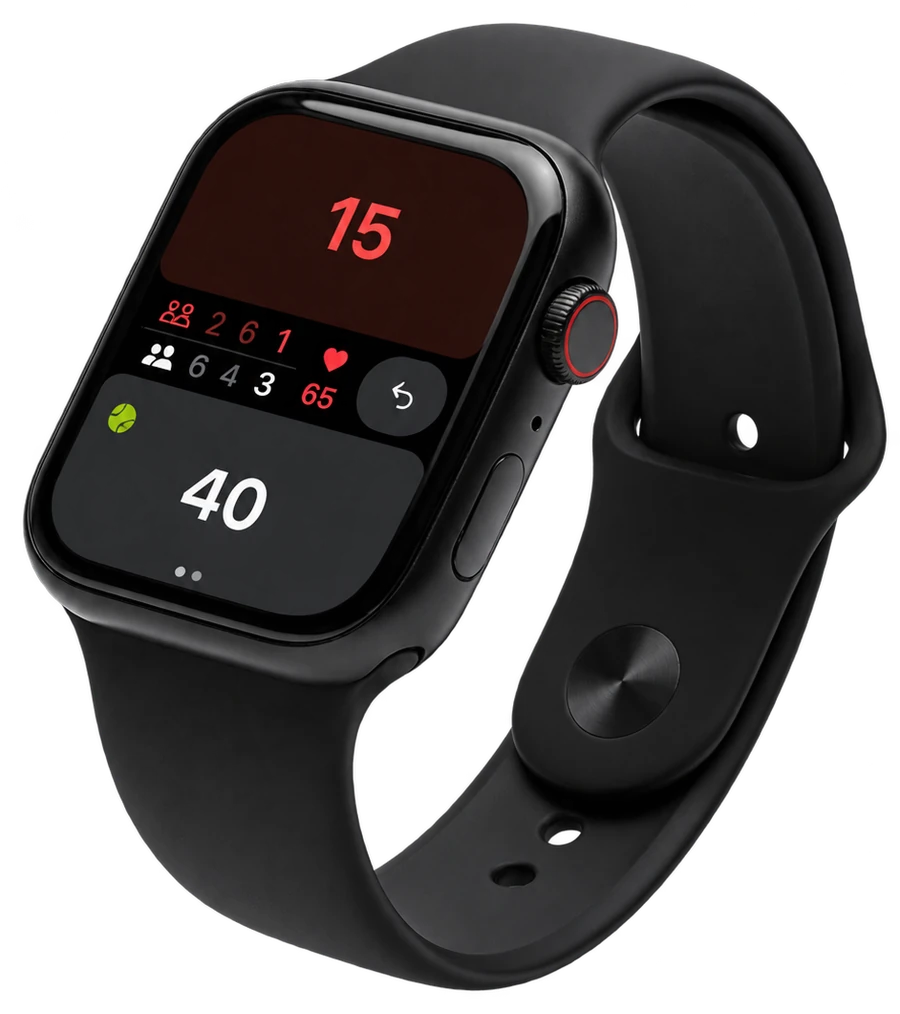
Padel Pointer showing a live padel score on Apple Watch

Does the duration gap survive a set-count comparison?

Switch between two and three stored sets. Compare the middle half of durations, the median, and the longer-session tail for each scoring format.

Stored set count

With 2 recorded sets, the Golden Point median was 42.8 minutes, compared with 45.7 for Advantage. These groups were not randomly assigned.

Elapsed duration distributions in minutes. Each row shows the middle half, median and 90th percentile.

Advantage45.7 min median

1,928 records · 727 recording profiles

Golden Point42.8 min median

615 records · 241 recording profiles

Silver Point44.4 min median

330 records · 120 recording profiles

Star Point45.6 min median

373 records · 113 recording profiles

Elapsed minutes, starting at zero for every format.

Box: 25th–75th percentiles. White dot: median (labelled). Line end: 90th percentile, not the maximum. Stored sets may include extra play or partial sets; this is not a validated straight-sets/deciding-set comparison.

Read the chart data as a table
FormatRecorded setsRecordsProfiles25th percentile minMedian min75th percentile min90th percentile min
Advantage21,92872737.545.75667.7
Golden Point261524135.242.85262.8
Silver Point233012036.244.453.161.5
Star Point237311337.945.656.268.3

Padel Pointer original research. 17 August–14 November 2026 inclusive; UTC. Production Watch records, internal/test accounts excluded, exact event UUID deduplication. Extracted 15 November 2026. Aggregate cells only; no personal identities, health readings or precise locations. Same completed set-match eligibility as the duration study, restricted to two or three stored sets. Percentiles are empirical summaries, not confidence intervals.

The question behind the deciding point

At deuce, Golden Point uses one deciding point; Advantage requires two consecutive points to win the game. That changes how a close game can end, but it does not fix the length of the rallies, the number of games or the closeness of a match.

We wanted to test a narrower question: among eligible Padel Pointer records, were durations different when the saved scoring format was Golden Point rather than Advantage? We also kept Silver Point and Star Point visible so the comparison would not imply that all deciding-point systems are interchangeable. This article studies durations; use the rules guides for the complete procedures.

Compare like recorded set counts before reading the headline

Grouping all records together would mix different amounts of recorded play. The explorer therefore separates records with two stored sets from those with three. In the two-set group, Golden Point’s median was 2.9 minutes below Advantage’s. In the three-set group, the difference between medians was 9.3 minutes. These are differences between group summaries, not the median saving for an individual player.

The stored set count is not a validated count of completed conventional sets. Some records may include extra play after the configured finish or a partial set. We do not label the groups “straight sets” and “deciding third set”. That distinction matters when you use the result to plan a booking.

Compare like recorded set counts before reading the headline
Stored setsAdvantage: median / recordsGolden Point: median / records
Two45.7 min / 1,92842.8 min / 615
Three68.3 min / 4,09759.0 min / 1,128

The overlap matters more than a tidy promise

With two stored sets, the middle half of Golden Point records ran from 35.2 to 52.0 minutes. Advantage’s middle half ran from 37.5 to 56.0. Those ranges overlap substantially. A Golden Point session can therefore be longer than an Advantage session; the median does not assign every match to a neat order.

The right end of each line shows the 90th percentile, not the longest record. The boxes show the middle half of observations, not confidence intervals. Switching to three stored sets reveals a different mix: Star Point had a median of 71.9 minutes in that group. That is not evidence that its deciding-point mechanism itself causes longer play.

A second check: elapsed seconds per recorded game

Whole-session times can also differ because groups record different numbers of games. In a narrower sensitivity check with two or three stored sets and 6–50 recorded games, the median elapsed seconds per game was 156.9 for Advantage and 142.3 for Golden Point. These ratios include whatever time the app clock captured; they are not measured rally durations.

Using the completed-duration eligibility and 6–50 recorded games, without restricting the stored set count, we also found 32 recording profiles with at least three eligible records in each of those two formats. Their median within-profile percentage difference in elapsed seconds per game was −5.2% for Golden Point relative to Advantage. This small paired comparison reduces one source of between-profile difference, but opponents, venues, match settings and timing can still differ. It is not a controlled experiment or a recommended time discount.

What to agree before your next match

Choose the scoring format before play and make sure everyone understands the finish. If you have a hard court deadline, also agree a stopping plan. Choosing a deciding-point format does not by itself guarantee that a full match will fit.

For your own comparison, keep the group and setup as similar as practical, record completed and unfinished sessions separately, and compare more than one outing. Avoid turning a single unusually long match into a conclusion about the rule. Padel Pointer lets you select supported scoring formats and keep the resulting match history; the choice of format should still follow your group or competition’s rules.

Methodology, privacy and interpretation

This is an observational convenience sample of people using Padel Pointer on Apple Watch, not a representative survey of padel. We count each match-create event UUID once and exclude internal/test accounts and non-production events. We do not add the separate Watch-import mirror event. A recording profile is an analytics identity, not a verified unique person. Two people recording the same physical match, device identities and re-imports with a new event ID can still overlap. The 90-day window is 17 August–14 November 2026, inclusive, in UTC; it is selected by record arrival, not a complete census of matches played in those dates.

For duration and format comparisons, we require a set-match record marked complete because its configured rules were reached, a recorded winner, elapsed time between 10 minutes and four hours, and a reported sync delay of at most 24 hours. The resulting 10,200 records came from 1,621 recording profiles. We exclude unfinished, missing/legacy-completion and implausible-duration entries rather than interpreting them as completed matches. Elapsed time is the app’s start-to-end game clock; it is not measured ball-in-play time or a guarantee that preparation and pauses are excluded.

The chart retains format/set-count groups with at least 100 eligible records from at least 20 profiles. A profile can contribute to multiple groups, so profile counts across rows must not be added. Completion and scoring format are app fields, not an independent audit of every point. The per-game and paired checks use their own stated eligibility, described above.

Published chart groups meet a minimum of 20 recording profiles and 100 eligible entries or set scores; profile-only routine groups need at least 20 profiles. We publish no names, account identifiers, raw individual records, health measurements or precise coordinates. Different charts have different eligibility rules, specified beside each result. This is a frozen study extracted on 15 November 2026, not a live dashboard. Results should not be generalised to all padel players.

Frequently asked questions

Does Golden Point guarantee a shorter padel match?

No. It changes the finish at deuce, but the observed groups overlap. Our data describes associations between saved scoring formats and elapsed records; it does not establish a causal time saving.

Are the chart boxes confidence intervals?

No. They show the 25th to 75th percentiles of recorded durations. The white dot is the median and the line extends to the 90th percentile. No inferential confidence interval is claimed.

Why separate two and three recorded sets?

It reduces one obvious difference in the amount of recorded play. The app’s stored set count can still include extra or partial sets, so it is not a verified classification of straight-set wins versus deciding-set matches.

Can I compare my own formats in Padel Pointer?

The app supports Classic/Advantage, Golden Point, Silver Point and Star Point setups and saves match history. Choose the setup before play and compare similar sessions; do not assume the group results predict your own next match.

Sources and evidence

Read next

Turn the insight into a better next match.

Track every point on Apple Watch, then understand momentum, patterns, and improvement areas on iPhone.

Padel Pointer scorekeeping on a black Apple Watch