The Padel Pointer courtside guide · September 2026
Padel rules PDF.
Ready for your next match.
A free, printable padel rules PDF for the moments you ask “wait, what happens now?” Scoring, serves, glass, fence and tie-break order, across four spacious, illustrated pages.
4 pages · A4 PDF · No email needed · Print double-sided or save to your phone
Read the rules on this page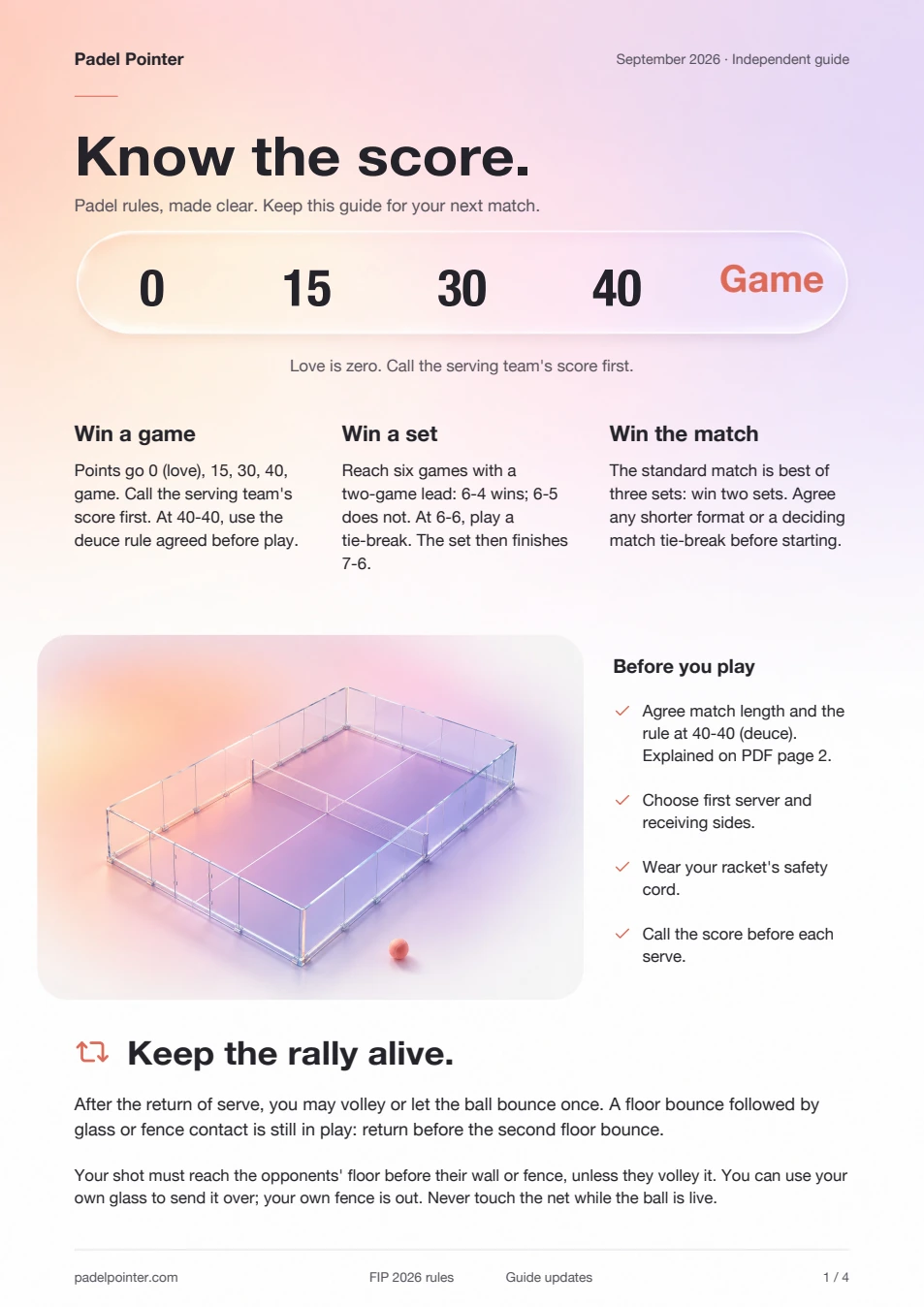
Know the score.
Say the serving team’s score first.
- Win a game
- Points go 0 (love), 15, 30, 40, game. Call the serving team's score first. At 40-40, use the deuce rule agreed before play.
- Win a set
- Reach six games with a two-game lead: 6-4 wins; 6-5 does not. At 6-6, play a tie-break. The set then finishes 7-6.
- Win the match
- The standard match is best of three sets: win two sets. Agree any shorter format or a deciding match tie-break before starting.
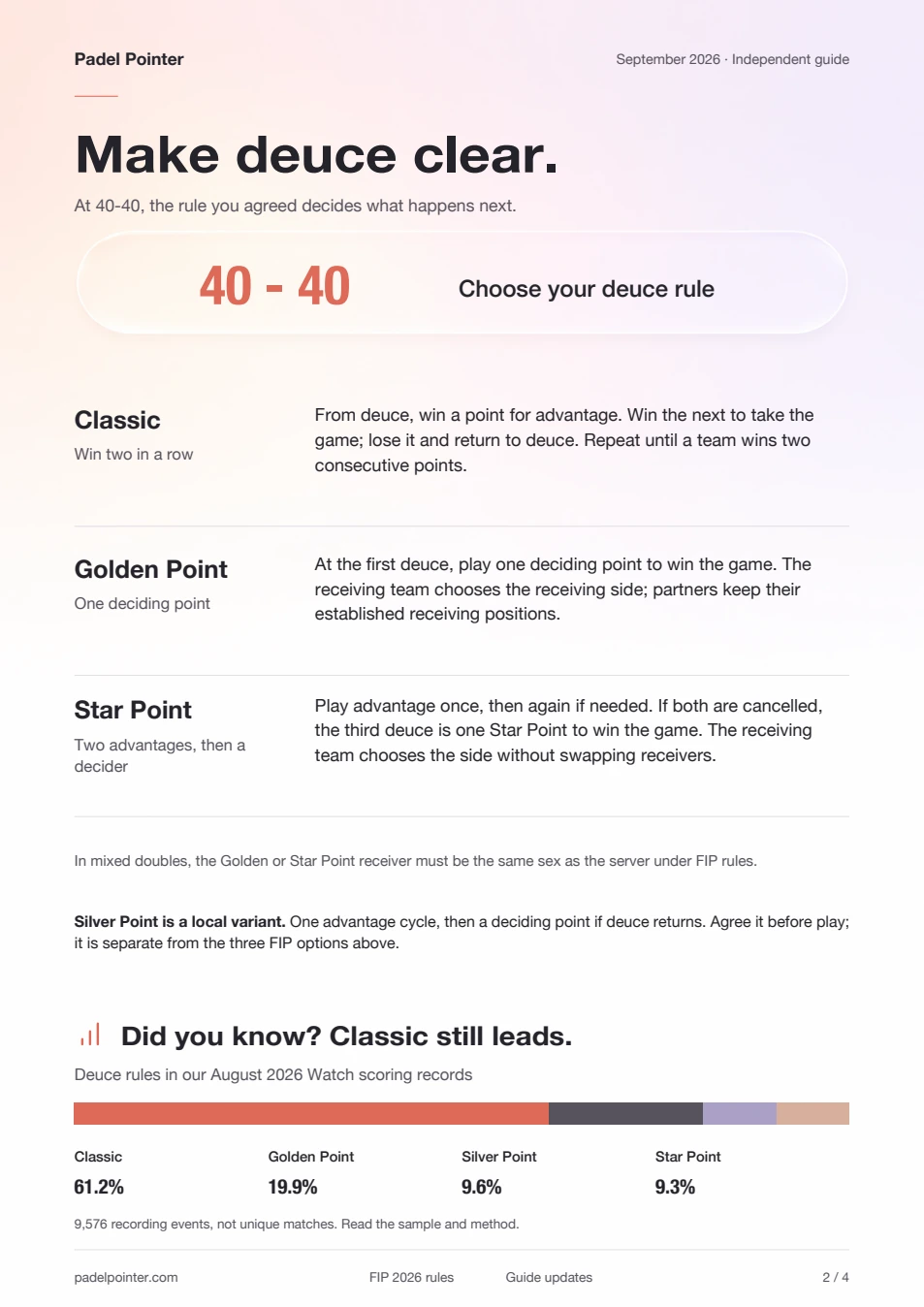
At 40–40, agree the rule.
A deciding point wins the game. Choose the format before the first serve.
- Classic / advantageWin two in a row
- From deuce, win a point for advantage. Win the next to take the game; lose it and return to deuce. Repeat until a team wins two consecutive points.
- Golden PointOne deciding point
- At the first deuce, play one deciding point to win the game. The receiving team chooses the receiving side; partners keep their established receiving positions.
- Star PointTwo advantages, then a decider
- Play advantage once, then again if needed. If both are cancelled, the third deuce is one Star Point to win the game. The receiving team chooses the side without swapping receivers.
In mixed doubles, the Golden or Star Point receiver must be the same sex as the server under FIP rules.
Playing Silver Point? Agree the local variant: one advantage cycle, then a deciding point if the score returns to deuce. It is separate from the three FIP scoring options above.
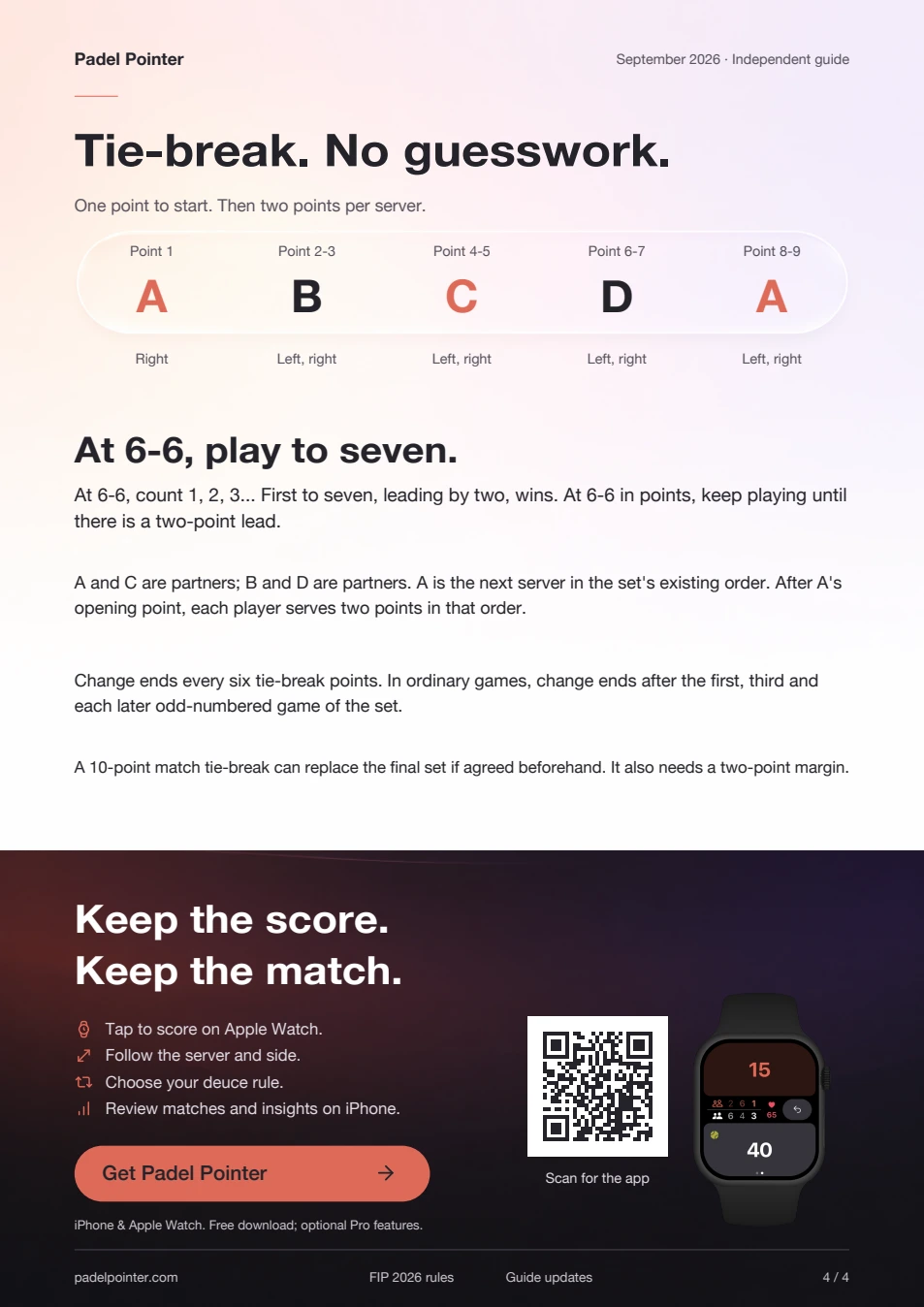
One serve. Then two each.
At 6-6, count 1, 2, 3... First to seven, leading by two, wins. At 6-6 in points, keep playing until there is a two-point lead.
| Point | Server | Serving side |
|---|---|---|
| 1 | A | Right |
| 2-3 | B | Left, right |
| 4-5 | C | Left, right |
| 6-7 | D | Left, right |
| 8-9 | A | Left, right |
A and C are partners; B and D are partners. A is the next server in the set's existing order. After A's opening point, each player serves two points in that order.
Change ends every six tie-break points. In ordinary games, change ends after the first, third and each later odd-numbered game of the set.
A 10-point match tie-break can replace the final set if agreed beforehand. It also needs a two-point margin.
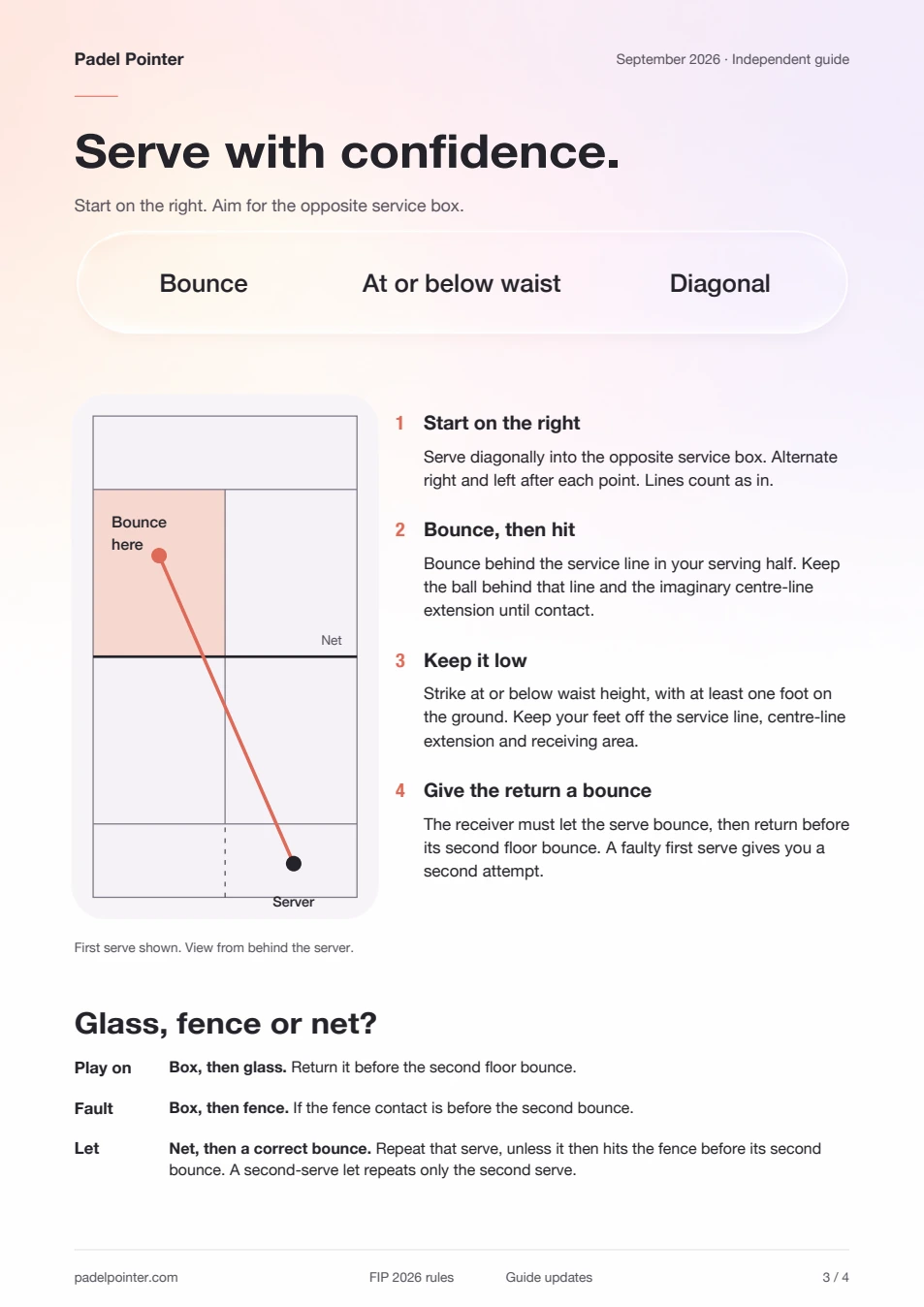
A good serve starts here.
Start from the right-hand half and serve diagonally.
Start on the right
Serve diagonally into the opposite service box. Alternate right and left after each point. Lines count as in.
Bounce, then hit
Bounce behind the service line in your serving half. Keep the ball behind that line and the imaginary centre-line extension until contact.
Keep it low
Strike at or below waist height, with at least one foot on the ground. Keep your feet off the service line, centre-line extension and receiving area.
Give the return a bounce
The receiver must let the serve bounce, then return before its second floor bounce. A faulty first serve gives you a second attempt.
Glass, fence or net?
The order of contact makes the difference.
- Serve lands in the box, then hits glass
- Play on. Return it before the second floor bounce.
- Serve lands in the box, then hits the fence
- Fault. If the fence contact is before the second bounce.
- Serve clips the net, then lands correctly
- Let. Repeat that serve, unless it then hits the fence before its second bounce. A second-serve let repeats only the second serve.
- Rally ball bounces, then hits glass or fence
- Play on. You may use the rebound before the second bounce.
- Your shot hits the opposite wall or fence first
- Point lost. It must reach the opponents' floor before their enclosure, unless an opponent volleys it.
After the serve return, volleys are allowed. You may play off your own glass to send the ball over the net; hitting your own fence loses the point. Do not touch the net while the ball is live.
Before the first point
- Agree match length and the rule at 40-40 (deuce). Explained on PDF page 2.
- Choose first server and receiving sides.
- Wear your racket's safety cord.
- Call the score before each serve.
Take the rules to your next match.
Save the four-page guide to your phone, print it for the court, or share it with your group before the warm-up. No email address or account needed.
Did you know? Classic still leads.
Classic advantage scoring appeared in 61% of our August Watch scoring records with a known deuce rule. Your group may play differently—that’s why it helps to agree before starting.
Based on 9,576 recording events with a known rule. This is an app sample, not a count of unique completed matches.
How we counted this
Source: Padel Pointer production analytics, 1-31 August 2026; queried 6 September. 9,576 Watch match-recording events with a recognised deuce rule; 44 undecided and 5 missing values excluded. Test accounts excluded. Events can include imports, repeat observations, training or unfinished play; they are not a deduplicated count of completed matches. Frequent recorders contribute more observations. This describes our app sample, not all padel players or a survey of preferences.
3,690 distinct analytics users recorded at least one production Watch match event between 29 January and 5 September 2026, excluding test accounts. This is a measured cohort, not total downloads or current active users; analytics identities may not correspond one-to-one with people.
Keep the score.
Keep the match.
The guide explains the rules. Padel Pointer helps you follow the match as you play.
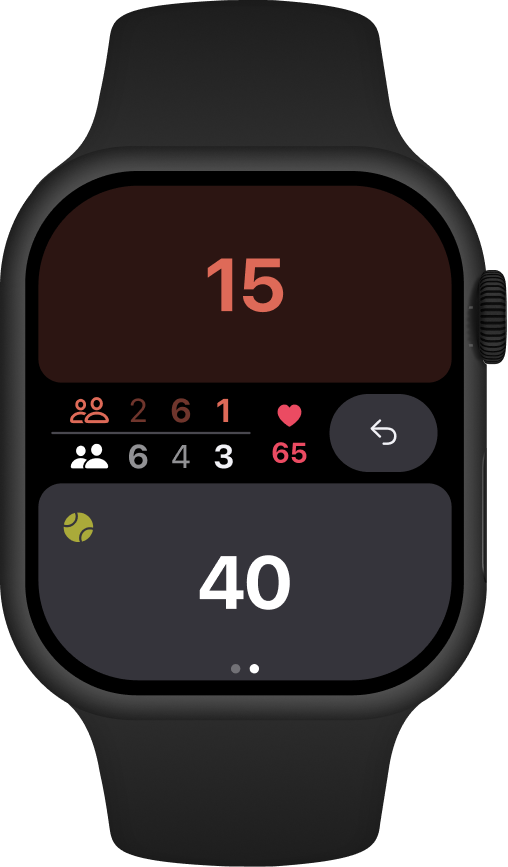
- Tap to keep score on Apple Watch.
- Follow the server, side and changeovers.
- Choose Classic, Golden, Silver or Star Point.
- Review match history and insights on iPhone.
For iPhone and Apple Watch. Free download; optional Pro features.

A few useful answers.
Should a padel rules PDF include the full official rulebook?
A courtside guide works best as a short reference to the serve, scoring, walls and tie-breaks. Keep the full official FIP rulebook available for competition decisions and detailed cases; it is linked below.
What is the most important section in a printable rules guide?
Start with the pre-match checklist: agree your deuce rule and match length, choose the first server and receiving sides, and check everyone understands the serve and tie-break order.
Can one printable guide work for beginners and regular players?
Yes. This guide starts with basic scoring and a pre-match checklist, then explains deciding points, serve faults, wall play and tie-break serving order. Share it with your group before the session and agree the format during the warm-up.
Is the padel rules PDF really free?
Yes. Download the complete four-page guide without an email address or account. You can print it, save it to your phone, or share the original PDF with your club and playing group.
Is this the official FIP rulebook?
No. This is an independent quick reference written by Padel Pointer and checked against the FIP rules effective 1 January 2026. The full official rulebook is linked below for competition decisions and detailed cases.
Does it explain Golden Point and Star Point?
Yes. It compares Classic advantage, Golden Point and Star Point, including what happens at deuce and who receives the deciding point. It also distinguishes the local Silver Point variant.
How should I print the guide?
Use A4 paper at actual size, or select fit to page for US Letter. For two double-sided sheets, choose flip on long edge. Colour preserves the illustrations and coral accents; the rules also remain readable in black and white.
Do I need the app to use the PDF?
No. The guide works on its own. Padel Pointer is an optional iPhone and Apple Watch app for recording scores, following the server and side, and reviewing match history.
Rules, sources and updates
Written by Padel Pointer. Rules checked on 6 September 2026 against the FIP edition effective 1 January 2026. This is an independent quick reference; competition regulations and the referee govern formal play.
- FIP Rules of Padel: scoring, tie-breaks, service and play
- FIP: how the Star Point sequence works
- Hazlemere Tennis & Padel Club: practical serve and wall-play explanations
Print at “fit to page” on A4 or US Letter. For two double-sided sheets, choose “flip on long edge”. Share the original PDF freely with your playing group or club.